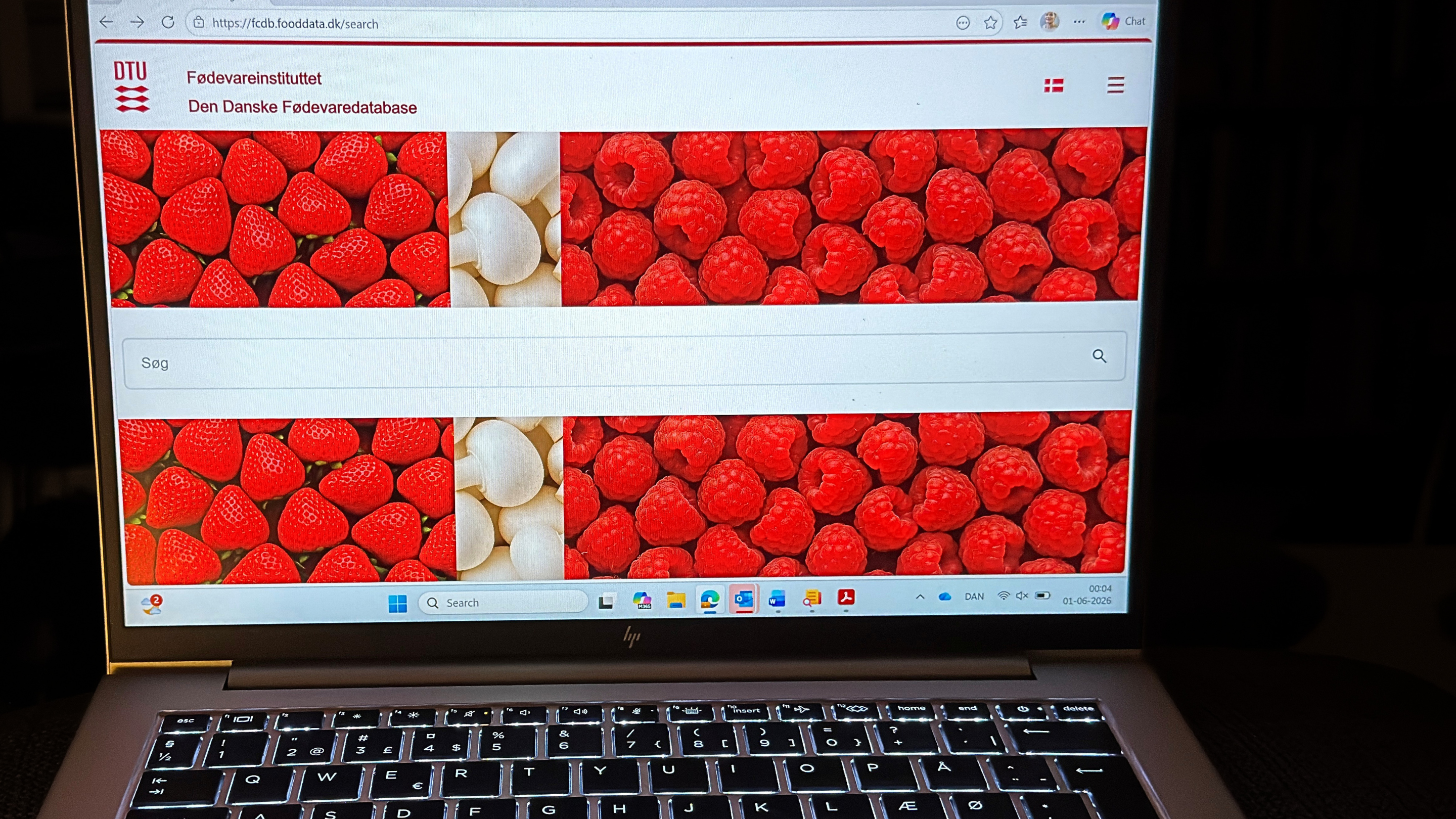
New interface improves access to the Danish Food Composition Database
DTU National Food Institute has launched an updated interface for the Danish Food Composition Database, making it easier to search, compare and export nutrient data for more than 1,400 foods.
A new interface provides easier access to nutrient data for more than 1400 foods.
Monday 01 June 2026
Sidsel Kretzschmer Henriksen
The Danish Food Composition Database is DTU National Food Institute’s public database on the nutrient composition of foods. It serves as a national reference for authorities, researchers, companies and educators, while also being accessible to anyone interested in nutritional information about foods.
Updated twice a year, the database contains nutrient data for more than 1,400 foods, including the most common products on the Danish market. While a standard nutrition label typically includes around seven nutrients, the database provides information on up to 150 nutrients per food item.
The latest update introduces both a new interface and nutrient data for ten new foods in the soups category. Documentation of the updates is available as a report at food.dtu.dk/publications.
Tailored access to nutrient data
The new interface is organised around three different user needs:
Consumer view provides a simple overview of the most frequently requested nutrient data
Nutrition declaration view supports work with nutrition labelling, including percentage of recommended daily intake
Professional view provides access to all available data and associated references
Data can also be visualised in charts illustrating both absolute and relative nutrient contents.
More flexible use of data
A key improvement is the possibility to display nutrient data based on portion sizes. Tables can also be exported directly to spreadsheets, making it easier to work further with the data.
The updated interface is designed to provide a more intuitive and flexible user experience, where relevant data is easy to access while still allowing users to explore the data in greater detail when needed.
Greater transparency and insight
The update also improves access to underlying information. Users can navigate to details about foods, nutrients, samples, sources, analytical methods and statistical considerations.
The database is based on international standards such as LanguaL, FoodEx2 and FoodOn. These metadata and technical descriptions are now also available through the interface, strengthening both transparency and usability for researchers, authorities and companies.